Solar BOS Enquiry Checklist: Specify Parts, Quantities and Documents
Check the minimum order value before sending your BOS request
For products other than solar panels, PV.market has a minimum order value of USD 10,000. Check the planned BOS purchase against this B2B minimum before requesting a quotation. For a mixed-product requirement, confirm how the minimum applies with the sales team.
Keep every cable, connector, mounting part and accessory on its own line with the exact specification, quantity and unit. A minimum order value does not establish the length per reel, contents per pack, component compatibility or freight and tax inclusions. Ask for these details separately in the written quotation.
Start with a line-item bill of materials
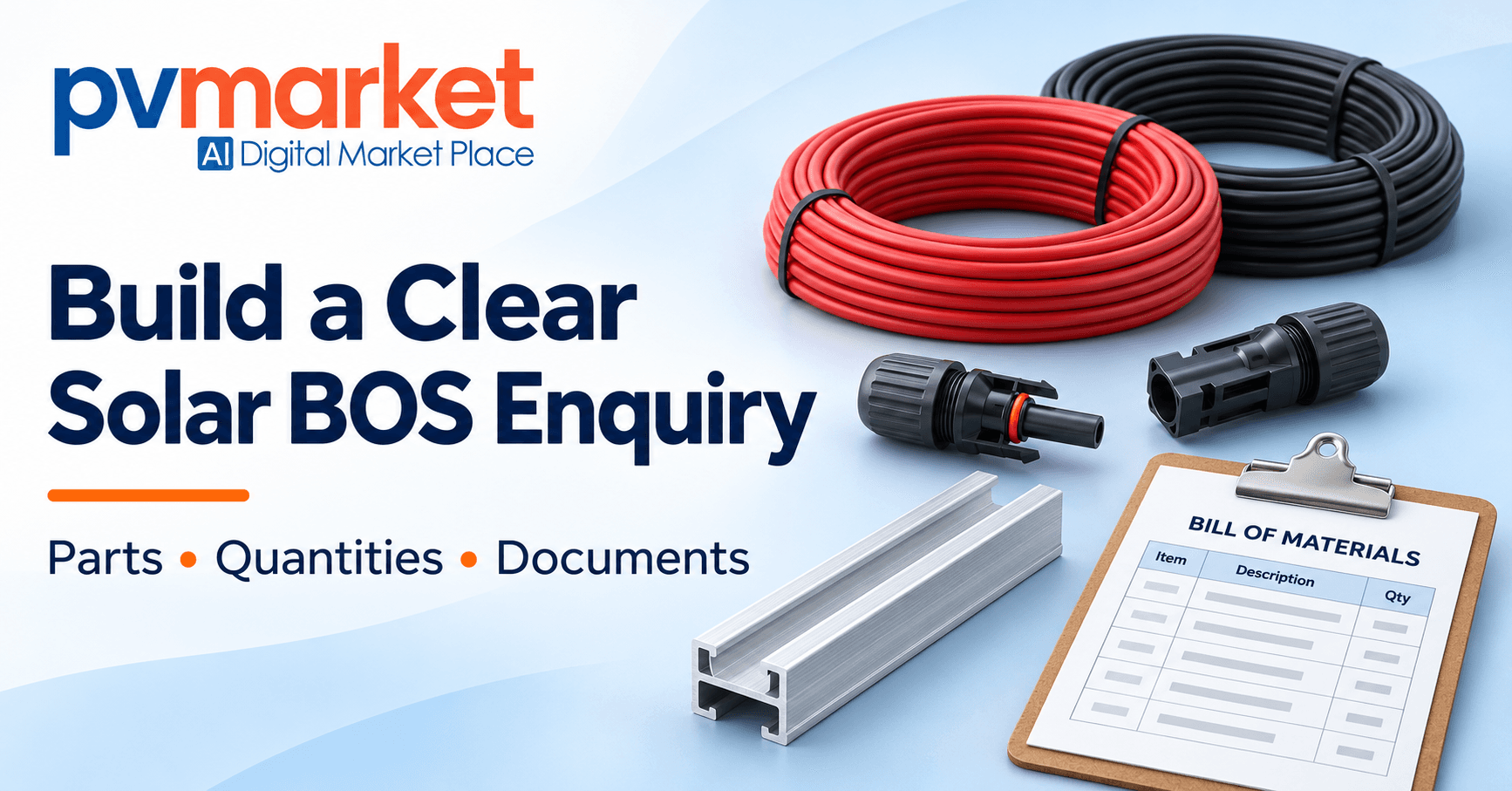
A balance-of-system enquiry is easier to compare when each component has its own line. A request for a complete solar kit can leave cable lengths, connector pairs, mounting interfaces and accessories undefined. This checklist helps procurement teams prepare the information a supplier needs; the project designer remains responsible for the equipment selection and installation design.
The PV.market BOS catalogue includes cables, PV connectors, mounting systems, protection components, controllers and supporting accessories. Browse the relevant category, then identify the exact item rather than assume that all components under BOS perform the same function. Listed products, quantities and prices can change; confirm the offer for your destination and required date.
1. Give every line an exact identity
Use a line reference, manufacturer, complete part number, product description, required quantity, selling unit and evidence reference. Include the suffix or variant that changes the supplied item. Where the design permits an alternative, state that it requires review rather than treating a similarly named part as interchangeable.
A useful enquiry line reads: Project line C01; manufacturer and complete cable part number, including any variant or packaging suffix; designer-specified conductor size and voltage rating; black sheath; required total length in metres; commercial selling unit and requested pack quantity; requested length per reel or cut piece and any designer-specified continuous-run requirement; applicable datasheet identifier and revision; delivery location and date; proposed alternatives requiring technical review before acceptance. Replace every placeholder with a confirmed requirement or mark it Pending. Do not use this example to select an electrical rating.
2. Separate cable length from pack quantity
For cables, record the approved conductor cross-section, colour, manufacturer reference, required rating and supporting document. Record total required linear length in metres separately from the commercial selling unit, requested reel or pack count and length per reel or cut piece. Include any designer-specified continuous-run requirement or mark it Pending. Ask the supplier to confirm supplied lengths, minimum order and cut-length restrictions before comparing prices.
For example, a requirement for 300 metres and an offer for three reels are comparable only after the supplier confirms the supplied length per reel. Keep any spare allowance separate and approved. Do not calculate cable size from a catalogue title or infer suitability for an installation from price or appearance.
3. Identify both sides of a connector pair
Record the connector manufacturer, product family, complete part numbers for both mating counterparts and the applicable assembly instructions. Identify any factory-fitted equipment connector that the purchased part must mate with, or mark its identity Pending for the project technical owner. State whether the selling unit means individual pieces, matched pairs, branch assemblies or a complete kit. For individual pieces, give each counterpart part number its own quantity. Ask the technical owner and supplier which separately documented conductor cross-section and cable outer-diameter limits apply to the exact connector, and whether the required contacts, seals, accessories and assembly tools are included, separately quoted or Pending. This record does not approve a mating combination or assembly method.
For the MC4 types covered by Stäubli MA231, the manufacturer gives separate selection tables for conductor cross-section and cable outer diameter, together with approved cable and tool requirements. Check the version and product scope of the instructions for the proposed parts. Ask the responsible technical owner to confirm the exact connector, cable, contacts, seals and required tools; a generic compatibility label does not complete that check. Read the manufacturer MA231 assembly instructions for the covered MC4 types.
Stäubli warns against cross-mating its PV connectors with products from another manufacturer. A similar shape or a generic compatibility label is not enough to establish a suitable mating pair. Ask for the exact manufacturer documentation applicable to the proposed parts and have the project technical owner resolve any uncertainty before ordering. See the manufacturer connector guidance linked below.
4. Define mounting and accessory scope
For mounting components, provide the project-approved interface requirements, module frame details, roof or ground-mount context and the relevant drawings or specification references. Identify rails, clamps, fasteners and other required parts with their selling units. For rails, distinguish total metres from piece count and length per piece; keep different clamp and attachment part numbers on separate lines. For a documented kit, request the itemized contents per kit, selling-unit basis and exclusions, then compare these with the project-approved bill of materials. Structural suitability and fixing design need confirmation by the responsible project professional.
For protection, monitoring, controllers and other accessories, specify the complete model and the approved project requirements. Ask which sensors, communication parts, connectors, software entitlements or installation accessories are included where relevant. A catalogue category or an accessory label does not prove compatibility with every inverter, battery or monitoring platform.
5. Attach evidence and make omissions visible
Keep a current bill of materials with the document identifier, revision or date and the exact part numbers covered. Ask the supplier to identify each offered alternative, missing line, quantity difference and proposed delivery split. Separate a product datasheet from evidence of stock availability and from any project-specific approval.
Before accepting a quotation, check line references, part numbers, quantities, units, pack contents and exclusions against the enquiry. Confirm currency, price basis, delivery terms, destination and requested timing for the transaction. Record unanswered questions explicitly instead of allowing an empty cell to imply that the supplier has included or approved something.
Send a quotation-ready BOS requirement
Use the PV.market request-for-quote page with your line-item requirements and the project information requested by the live form. Include the equipment scope, quantities, delivery destination and required timing, and describe any supporting documents that the team needs to review. Use the attachment or follow-up route actually available in the form or advised by the team; do not assume every file type or upload route is supported.
Supporting links: browse BOS components; check product models and documents; compare supplier quotations; read Stäubli connector guidance. Primary next step: request a BOS quotation.
Return to your market RFQ
Leave a Comment
Comments
No comments yet. Be the first to comment!