How to Verify Solar Equipment Models and Documents
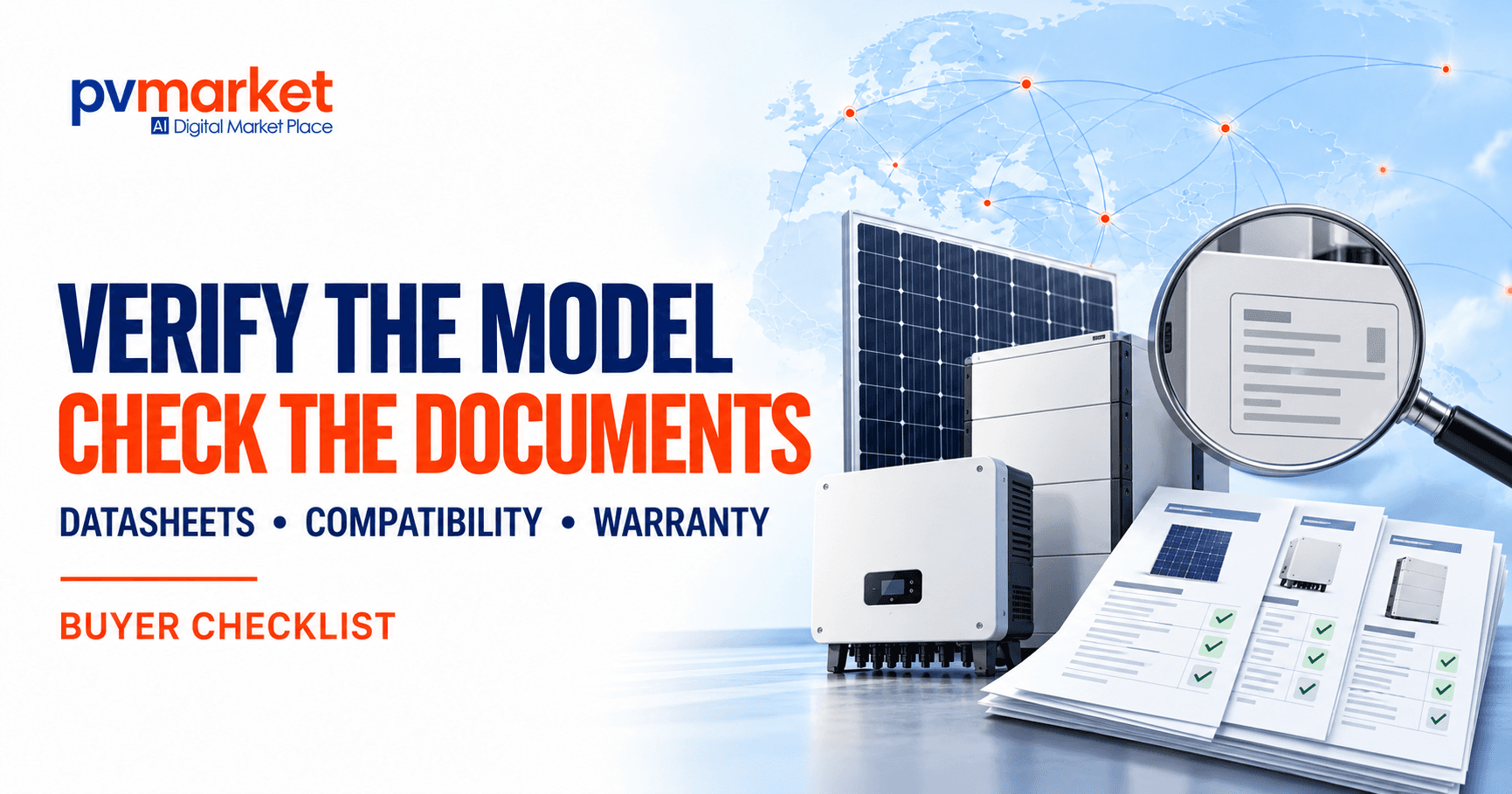
Before ordering solar equipment, check that the quotation, product identification and supporting documents describe the same supplied item. A familiar brand name, product-family brochure or similar power rating is not enough to resolve a model or revision mismatch.
Use this buyer checklist to collect evidence and record unanswered questions. Ask the manufacturer or your project specialist to confirm suitability where technical interpretation is needed. Document collection is not a substitute for engineering review or project approval.
1. Record the full supplied identity
Ask the supplier to state the manufacturer, complete model code, suffix and any relevant hardware revision in the quotation. Record the quantity, sales unit, included accessories and condition being offered. Keep alternatives on separate lines so they cannot silently replace the requested model.
Request clear photographs of the product label and packaging for the offered stock when available. Record the serial or batch identifiers supplied and establish when the final unit-level identifiers will be available. A sample label or photograph alone does not establish authenticity or confirm that every unit in the shipment matches.
2. Match the datasheet and its revision
Obtain the datasheet from the manufacturer’s official product or support channel where possible. Record its document title, issue date or version, source URL and the date you retrieved it. Check that the exact model or applicable variant is included. A newer document is not automatically the correct document for older stock.
Have the project specialist check the fields that matter for the application. Examples include module dimensions and electrical ratings, inverter phase and voltage requirements, battery configuration and usable versus nominal capacity, and BOS component ratings or dimensions. Keep quantities and units attached to each value; do not copy a figure from a neighbouring model column.
3. Build a document pack for each item
Request the applicable datasheet, installation or operating manual, warranty terms, and any product certificates or test documents required by the project. Where equipment must work together, include the manufacturer’s compatibility evidence. Ask which documents are supplied now and which will accompany delivery.
Keep commercial and product evidence distinct. The quotation describes the offered scope and terms; a datasheet describes product specifications. A packing list describes a shipment. One document should not be treated as proof of everything covered by the others.
4. Confirm compatibility for the exact combination
For equipment combinations such as an inverter and battery, identify both full model codes and the proposed configuration. Request the applicable manufacturer compatibility list, manual or written technical confirmation. Record any stated firmware, module-count, accessory or configuration conditions.
Do not assume matching brand names, connector shapes or headline voltage establish compatibility. Ask the manufacturer or project specialist to review the complete combination and installation requirements. Keep unresolved combinations pending instead of labelling them compatible.
5. Check the source and scope of certificates and warranties
For a certificate or test document, record the issuer, document number, covered model or product scope and any stated validity information. Check the issuing organisation’s official verification route where available, or ask it to confirm the document. A logo or scan by itself is not evidence that the offered model is covered.
Ask the project specialist to confirm which approvals apply to the project and destination. This checklist does not establish local compliance or approve an installation.
For warranty documents, identify the issuer, applicable model and market, start-date conditions, exclusions, required proof of purchase and the claim contact. Keep product and performance warranties separate where both exist. Refer unanswered coverage questions to the issuer instead of relying only on a headline duration.
6. Resolve conflicting information before ordering
If the title, quotation, label and datasheet disagree, list the conflict precisely and ask for written clarification tied to the supplied stock. For example, confirm the length sold per cable roll rather than assuming a standard packing length in a brochure applies to the offer. If two document revisions give different dimensions or ratings, ask which revision matches the stock.
Keep the disputed value marked pending until the evidence is consistent. Ask for a corrected quotation or product description when necessary. Do not combine favourable figures from different revisions into a specification that no document supports.
7. Keep a verification record and delivery check
Use one record per item with these fields: requested model; quoted model; label model or batch reference; document title/version/source; relevant requirement; evidence received; open question; responsible reviewer; review date; and outcome. Use clear outcomes such as matched, mismatch or pending. Record who approved any substitution.
Before shipment, confirm the agreed document pack and identification details. At receipt, compare the delivered labels, quantities and documents with the final agreed record. Record discrepancies and contact the supplier through the agreed process. Keep the quotation, clarification messages and final documents together for later support or warranty enquiries.
8. Use manufacturer resources as starting points
LONGi’s resource library separates product datasheets, certificates, installation instructions and warranty documents. Choose the appropriate product and region rather than assuming every document applies to your order.
Sungrow’s published compatibility list is an example of a versioned document with model and configuration conditions. The linked example is dated 23 October 2025, version 3.9; it is not a declaration that a particular pv.market listing is compatible. Obtain the applicable current guidance for your supplied models and market.
For your next enquiry, include exact-model and document requirements in the RFQ. When quotations arrive, compare the same supplied scope and keep unresolved evidence visible before deciding.
Leave a Comment
Comments
No comments yet. Be the first to comment!