Solar BOS Enquiry Checklist: Specify Parts, Quantities and Documents
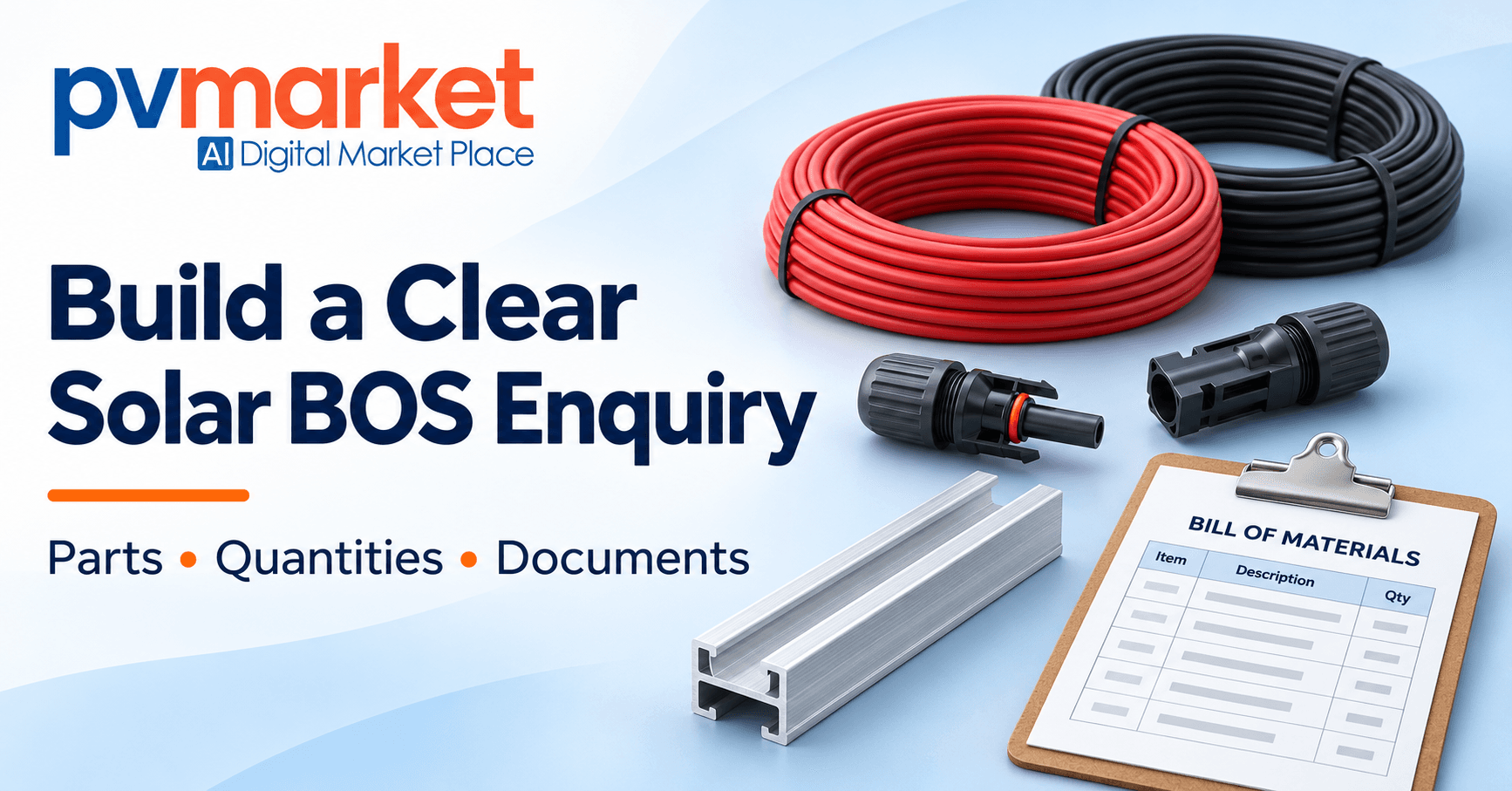
Start with a line-item bill of materials
A balance-of-system enquiry is easier to compare when each component has its own line. A request for a complete solar kit can leave cable lengths, connector pairs, mounting interfaces and accessories undefined. This checklist helps procurement teams prepare the information a supplier needs; the project designer remains responsible for the equipment selection and installation design.
The PV.market BOS catalogue includes cables, PV connectors, mounting systems, protection components, controllers and supporting accessories. Browse the relevant category, then identify the exact item rather than assume that all components under BOS perform the same function. Listed products, quantities and prices can change; confirm the offer for your destination and required date.
1. Give every line an exact identity
Use a line reference, manufacturer, complete part number, product description, required quantity, selling unit and evidence reference. Include the suffix or variant that changes the supplied item. Where the design permits an alternative, state that it requires review rather than treating a similarly named part as interchangeable.
A useful enquiry line reads: Project line C01; manufacturer and complete cable part number; designer-specified conductor size and voltage rating; black sheath; required length in metres; requested reel length; applicable datasheet identifier and revision; delivery location and date. Replace every placeholder with a confirmed requirement. Do not use this example to select an electrical rating.
2. Separate cable length from pack quantity
For cables, record the approved conductor cross-section, colour, manufacturer reference, required rating and supporting document. State the total length needed and whether that quantity is in metres, reels or another pack unit. Ask the supplier to confirm the length per reel and any minimum order or cut-length restrictions before comparing prices.
For example, a requirement for 300 metres and an offer for three reels are comparable only after the supplier confirms the supplied length per reel. Keep any spare allowance separate and approved. Do not calculate cable size from a catalogue title or infer suitability for an installation from price or appearance.
3. Identify both sides of a connector pair
Record the connector manufacturer, product family, complete part numbers for both mating counterparts, cable-size range and the applicable assembly instructions. State whether the quantity means individual connectors, matched pairs, branch assemblies or a complete kit. Confirm which contacts and accessories are included.
Stäubli warns against cross-mating its PV connectors with products from another manufacturer. A similar shape or a generic compatibility label is not enough to establish a suitable mating pair. Ask for the exact manufacturer documentation applicable to the proposed parts and have the project technical owner resolve any uncertainty before ordering. See the manufacturer connector guidance linked below.
4. Define mounting and accessory scope
For mounting components, provide the project-approved interface requirements, module frame details, roof or ground-mount context and the relevant drawings or specification references. Identify rails, clamps, fasteners and other required parts separately when they are not supplied as a documented kit. Structural suitability and fixing design need confirmation by the responsible project professional.
For protection, monitoring, controllers and other accessories, specify the complete model and the approved project requirements. Ask which sensors, communication parts, connectors, software entitlements or installation accessories are included where relevant. A catalogue category or an accessory label does not prove compatibility with every inverter, battery or monitoring platform.
5. Attach evidence and make omissions visible
Keep a current bill of materials with the document identifier, revision or date and the exact part numbers covered. Ask the supplier to identify each offered alternative, missing line, quantity difference and proposed delivery split. Separate a product datasheet from evidence of stock availability and from any project-specific approval.
Before accepting a quotation, check line references, part numbers, quantities, units, pack contents and exclusions against the enquiry. Confirm currency, price basis, delivery terms, destination and requested timing for the transaction. Record unanswered questions explicitly instead of allowing an empty cell to imply that the supplier has included or approved something.
Send a quotation-ready BOS requirement
Use the PV.market request-for-quote page with your line-item requirements and the project information requested by the live form. Include the equipment scope, quantities, delivery destination and required timing, and describe any supporting documents that the team needs to review. Use the attachment or follow-up route actually available in the form or advised by the team; do not assume every file type or upload route is supported.
Supporting links: browse BOS components; check product models and documents; compare supplier quotations; read Stäubli connector guidance. Primary next step: request a BOS quotation.
Leave a Comment
Comments
No comments yet. Be the first to comment!